Subterranean termite infestations in Greenville County pose a persistent threat to structural integrity due to the region's warm temperatures and heavy annual rainfall. According to the Clemson University Department of…
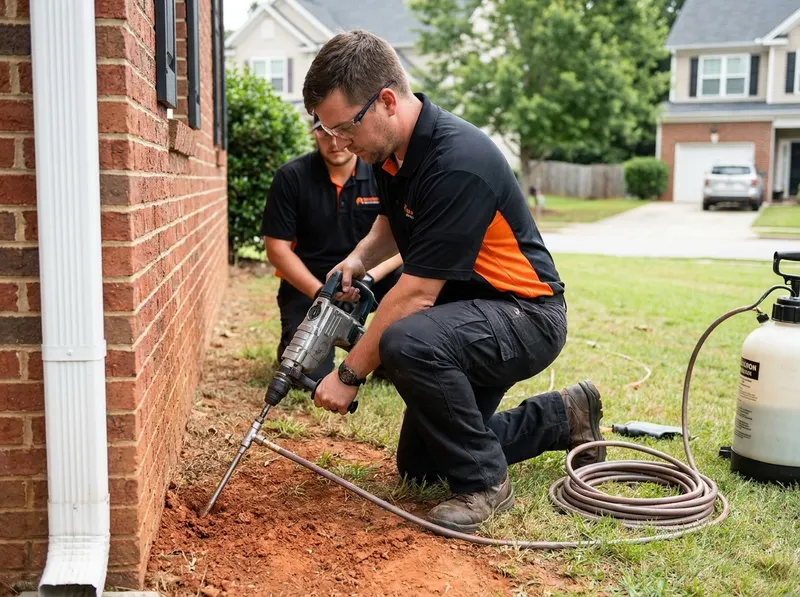
Subterranean termite infestations in Greenville County pose a persistent threat to structural integrity due to the region's warm temperatures and heavy annual rainfall. According to the Clemson University Department of Pesticide Regulation, eastern subterranean termites (Reticulitermes flavipes) account for the vast majority of wood-destroying insect damage across Upstate South Carolina. The local soil structure, predominantly Cecil sandy loam mixed with dense red clay, retains moisture around historic foundation perimeters in neighborhoods like North Main, Overbrook, and Augusta Road. In older crawl space homes, subterranean workers construct earthen mud tubes across masonry piers to reach subflooring, sills, and joists. Establishing a continuous liquid barrier binds termiticide active ingredients directly into the clay matrix, transferring undetectable non-repellents through the colony through natural social grooming to neutralize the queen.
Treatment selection balances immediate liquid soil barriers against monitored bait stations. A liquid application using termiticides regulated under EPA Federal Insecticide, Fungicide, and Rodenticide standards provides an immediate chemical envelope along exterior stem walls, while bait systems like those evaluated by the USDA Agricultural Research Service rely on worker consumption over weeks. For slab-on-grade homes in newer subdivisions like Verdae or perimeter crawl space properties near Gower Estates and Parkins Mill, the physical trade-off involves access: slab treatments require precise vertical interior drilling near plumbing fixtures, whereas crawl space structures require technicians to crawl along interior footings to dig narrow soil trenches. Standards established by the National Pest Management Association require treatment to encompass every square foot of contact between structural soil and masonry to prevent bypass. CanyonFern Pest Specialists applies low-odor formulations that bind firmly to Piedmont red clay, preventing runoff into adjacent yard soil or local waterways like the Reedy River.
The application process follows a disciplined, step-by-step engineering standard to ensure structural defense without unnecessary disruption to household living spaces. Step 1 involves an exhaustive interior and exterior foundation sweep, measuring moisture levels and charting crawl space masonry footings. Step 2 requires trenching a continuous 6-inch by 6-inch channel in the soil around the exterior foundation perimeter. Step 3 introduces the non-repellent liquid into the trenched soil at a precise volume of 4 gallons per 10 linear feet per foot of depth, strictly observing OSHA chemical handling safety protocols. Step 4 treats expansion joints and porch abutments through systematic drilling spaced roughly 12 inches apart to safeguard structural thresholds. Step 5 backfills and tamps all displaced soil back into place, sealing drill sites with clean non-shrink hydraulic masonry cement.
Specific architectural configurations across Alta Vista, West End, Dunean, and Botany Woods dictate minor variations in remediation scope. Pier-and-beam foundations require individual treatment along every support pillar under the center of the structure, raising linear foot requirements compared to modern slab construction. Moisture-laden crawl spaces often require mechanical adjustments, as highlighted by HUD Housing Structural Standards, because unvented crawl space humidity above 70 percent accelerates wood decay and softens cellulose surfaces, accelerating termite colonization rates. All services conducted by CanyonFern Pest Specialists remain strictly agreement-based with no forced multi-year contracts, letting property owners protect family living areas, children, and pets without long-term paperwork locks.
Every job gets a firm, written price after an on-site visit.
Tell us about your subterranean termite treatment job in Greenville and we'll send a clear, written quote, usually the same day.
 CanyonFern Pest Specialists