Residential properties throughout Greenville County face heavy biting-insect pressure fueled by regional humidity, dense tree canopies, and summer storms. Properties near the riparian zones along the Falls Park on the…
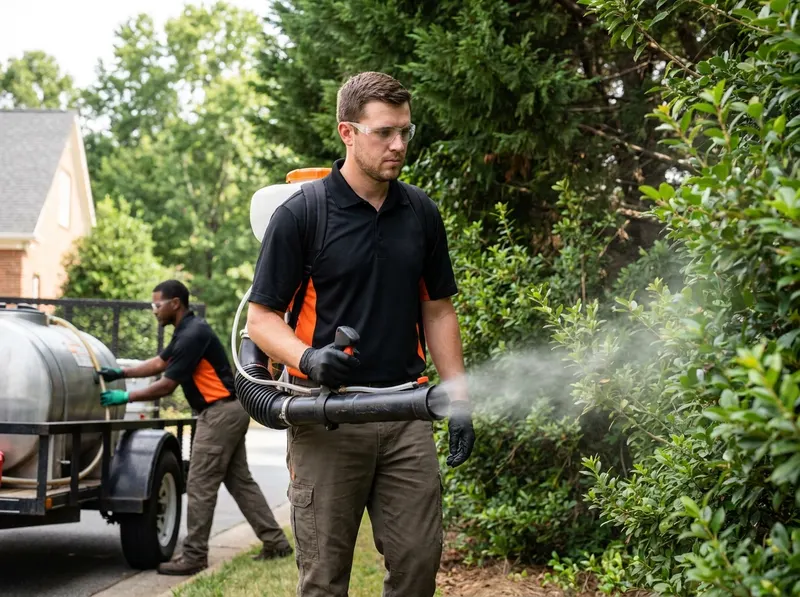
Residential properties throughout Greenville County face heavy biting-insect pressure fueled by regional humidity, dense tree canopies, and summer storms. Properties near the riparian zones along the Falls Park on the Reedy corridor, as well as shaded lots in North Main, Augusta Road, and Alta Vista, frequently contend with the invasive Asian tiger mosquito. Unlike native varieties, this species breeds in micro-reservoirs as small as a single discarded bottle cap. CanyonFern Pest Specialists applies targeted biological controls, including Bacillus thuringiensis israelensis, directly into clogged gutters, shaded bromeliads, and low-lying red-clay depressions to halt mosquito larvae before emergence. Mature insects resting on the undersides of boxwoods, broadleaf groundcovers, and crawlspace vents receive micro-encapsulated natural plant oils, adhering to Clemson University Department of Pesticide Regulation application standards without coating open lawn play spaces.
Controlling biting pests in established neighborhoods such as Overbrook, Gower Estates, and Parkins Mill requires addressing localized hydrology. Hardpan red-clay subsoils throughout the Piedmont plateau hold water along foundation beds and property boundaries. In rolling terrains like those bordering Paris Mountain State Park and Botany Woods, natural runoff creates stagnant micro-pools that foster black fly larvae in slow-seeping trickles. CanyonFern Pest Specialists maps these environmental vulnerabilities. The protocol targets resting canopies and damp soil perimeters up to a 10-foot vertical height, leaving flowering pollinator gardens undisturbed pursuant to Pollinator Partnership recommendations.
Urban properties in West End and historic mill developments in Dunean present compact outdoor footprints where patio comfort directly dictates living space usability. For properties bordering the Swamp Rabbit Trail or urban drain networks near Verdae, biting fly activity peaks during late-afternoon humidity spikes. CanyonFern Pest Specialists isolates perimeter fences, brick retaining walls, and dense shrubbery to establish a residual defense boundary using compounds regulated under the Federal Insecticide, Fungicide, and Rodenticide Act. Technicians confirm all property measurements on-site before applying any barrier, ensuring exact pricing and safety for households with pets, fish ponds, or backyard apiaries.
Executing mosquito and biting fly suppression follows a structured sequence designed to protect non-target organisms across domestic yards:
Deciding between single seasonal events and continuous suppression depends on local topography and water tables. A single barrier application protects outdoor family gatherings or weekend patio events for 14 to 21 days; however, seasonal reduction schedules provide sustained biological control across the 6-month Piedmont warm season from April through October. Continuous management prevents overlapping generations of biting midges and flies from establishing entrenched harborage in mature landscape plantings, eliminating the need for reactive, high-volume chemical saturation. Technicians monitor municipal water mitigation advisories from the South Carolina Department of Health and Environmental Control to align residential applications with broader county vector control initiatives, preserving local ecosystems while securing private perimeter safety. To arrange an initial evaluation, call (864) 215-5116.
Every job gets a firm, written price after an on-site visit.
Tell us about your mosquito and biting fly reduction job in Greenville and we'll send a clear, written quote, usually the same day.
 CanyonFern Pest Specialists